

Two competitions caught my eye this month. The first is the Arundel Festival Theatre Trail competition which is free-to-enter and with fantastic opportunities for the winner. In addition to a small financial prize, the play will be performed as a part of the Arundel Festival in 2020. The submission date is 31st January 2020. (photo Arundel Festival. Copyright. Charlie Warring).
The second is the Scottish Arts Club short story competition with a good financial prize and publication in an anthology for the winners.
Both have their downsides: I have never written or even attempted to write a script. The deadline for the Arundel Festival submission is the end of January so leaves me very little time.
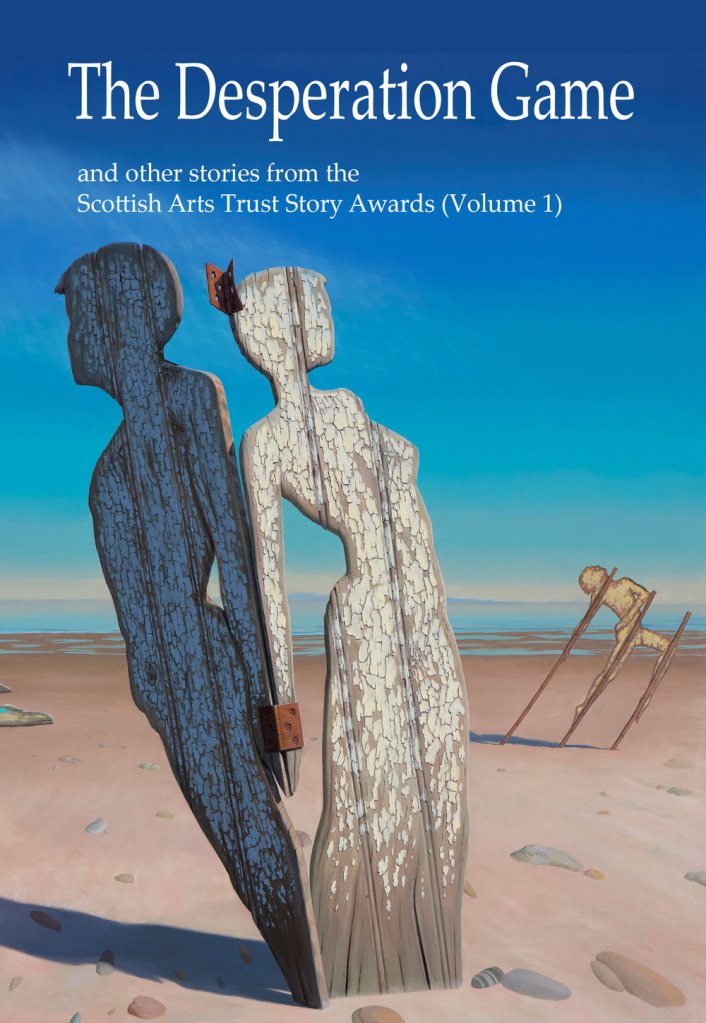
The second competition also (already) breaks my own rules for free-to-enter competitions but it still tempts because of the calibre of entries it attracts. The stories in the previously published anthology ‘The Desperation Game’ (Eds: McBean, SC and Munro, H, 2019) are excellent.
Also, I have a bountiful collection of story ideas filed away in my Evernote folder, each hankering to be called upon. In truth, creating stories is not difficult for me (telling them well is the challenge). Writing 2,000 words does not feel as intimidating as writing in a form I have never even thought of tackling before and yet I lean towards having a go at a script. I think it highly unlikely I can produce a script worth submitting but the goal of my blog this year is, for me, writing-craft development so here goes – the script it is.
My ‘how to write a play script’ notes
The invitation to submission says scripts must be for a play of 30 – 40 minutes, easily staged with minimum props and a maximum of five performers. Although there are caveats to the general rule, the consensus in on-line blogs seems to suggest that a page of script equates to a minute performed.
The script must be presented in a specific way. It must, of course, have the dialogue – how the actors tell the story. The stage direction about what needs to be on, or happening on a set. The script itself must delineate between each element through how the script is formatted (i.e. use of italics or capitals). Fortunately, I have some help with this as I use the excellent Scrivener which has a script template I very much hope will make the process easier.
I have a story in mind, and I think I can best organise this around two acts but think I will need at least four or maybe even five scenes to tell the story. Before I even begin to write, I wonder if this will make such a short script far too busy. I may need to give this more thought.
Research suggests plays must consist of five parts

Exposition
The introduction of the characters and ensuring the background information about the aspects which needs to be known is shown. This stage of the play should also set the mood and connect the audience with the material. In such a short play, it seems to me that the story must be relatively simple but the exposition must be quite a hook to ensure that the characters are relatable and of interest. I have what I think is a strong idea for a setting for my play and a well-formed set of distinctive characters who I can already see in my mind’s eye (I find myself already liking some of them which is a good start).
Rising action
I have a clear idea of the first and perhaps most crucial incident that causes a ‘moment’ – a ‘tension’ in the plot and is the hook upon which the rest of the story unfolds. The initial tension must be followed by other relevant conflicts between and within characters to carry the overall story. I am less clear at this point about how to hold onto the tension beyond the initial action point and will need to do more story crafting on this. I vacillate between being a plotter and pantster when writing stories anyway so although, for a new type of writing, I would rather be clear about where the story is going I will try to enjoy the ‘let’s see what happens’ element of writing it.
Climax
There must be a critical turning point which changes everything for the key character(s). This might mean drawing upon alluded to, but hidden, inner strengths of the character. In my story, lives must change – there is no option, and individuals must themselves change to accommodate the broader situation. In doing so, some characters will draw on others for support. I can articulate this as a general story, but at this point, I have no idea how to tell this exclusively in dialogue and within the constraints of acts and scenes! I am not sure whether I am excited or intimidated.
Falling action
This part of the story is where the story wrap takes shape towards the outcome. In this part of the story, it should be clear that something has happened and there has been a shift or a significant change. This part of the story needs to lead to the resolution of the story. My pre-writing story planning is woolliest here. I can imagine all kinds of elements to it, but they seem somewhat wishy-washy. I hope this can be resolved in writing.
Resolution
The end of the story. Conflicts and tensions are resolved, the story and character arcs are complete, and the audience must feel that this story has come to a good stopping point, but with a hope of more that could be told. The resolution needs to make sense and be rationally in-line with what has happened (no ‘and they were unexpectedly kidnapped by aliens’ moments). There should be a sense of satisfaction and completion for the audience

Story and plot
My story fits firmly in an ‘up-lit’ genre. It is a story of community, kindness, friendship and hope. I aim for it to be tenderly funny in exploring complex connections between a diverse group of people and to show how such an environment can engender calm over chaos and smooth frictions. I like the story, which also takes me right out of my writing comfort zone (I more usually write crime stories). This is by no means a new story but, of course, so few are. What will hopefully make it worth telling is how I manage to deliver it – or in other words, the plot. I am less clear about the plot – the not necessarily chronological events within the story that come together to enable the parts of the play to meet a dramatic and satisfactory conclusion. I know it depends mainly on how I show relationships between characters. I have a lot of work to do over the next ten days.
I will publish my entry on this site, whatever the outcome, once the competition has been concluded. Wish me luck!




 LF Meleyal